

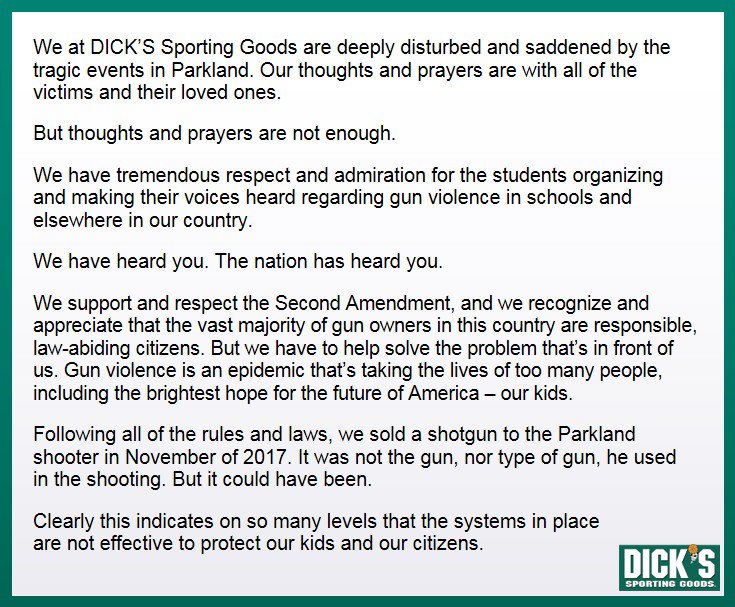
Some customers have decided to boycott Dick’s Sporting Goods because they have recently made a decision to not sell any assault weapons to people. The sporting goods store decided not to sell any weapons because of a recent attack at a school where the gunman had bought a gun from Dick’s Sporting Goods and used it to kill people.
Customers Threaten to Boycott Dick’s Sporting Goods Over Decision Not to Sell Assault Weapons
Did the Dick’s Sporting Goods Boycott Work? Five Years Later
Published by US Patriot Flags | Preserving Confederate Heritage
In February 2018, Dick’s Sporting Goods CEO Ed Stack walked to a podium and announced that his company — the largest sporting goods retailer in America — would stop selling AR-15-style rifles and refuse to sell any firearm to anyone under 21. He did it two weeks after the Parkland school shooting, citing a discovery that Dick’s had sold the shooter a shotgun — not the rifle used in the attack, but close enough to give Stack what he called “a pit in our stomach.”
The backlash was immediate. Gun owners, Second Amendment advocates, and thousands of long-time customers called for a boycott. Firearms manufacturers cut ties. The NRA issued statements. Online forums filled with pledges never to shop there again.
Seven years later, it’s worth asking the question directly: Did the boycott work?
The numbers give a clear answer. And it’s not the one the boycotters wanted.
What Dick’s Actually Did — The Full Timeline
The story is bigger than most people remember. Stack didn’t just stop selling AR-15s. He systematically dismantled the firearms business his father had built since 1948:
- February 2018: Stopped selling assault-style rifles and high-capacity magazines. Raised minimum age for all firearm sales to 21.
- April 2018: Announced the company would destroy its remaining assault rifle inventory rather than return it to manufacturers or sell it to another retailer. An estimated $5 million worth of rifles were turned into scrap metal.
- Fall 2018: Pulled all guns from 10 test stores and replaced them with higher-margin merchandise.
- 2019: Expanded the gun-free format to 125 stores after the test showed those locations outperformed the rest of the chain.
- March 2020: Announced plans to remove guns from over 400 additional stores. Dick’s stock surged 13% on that news.
- 2022–2023: Removed all firearms and hunting equipment from remaining stores in Maine following the Lewiston mass shooting.
Stack acknowledged the financial cost directly. In a 2019 CBS News interview, he said the gun policy changes cost Dick’s “about a quarter of a billion dollars” in revenue.
He also said he’d do it all over again.
What the Boycott Crowd Said Would Happen
The argument from gun-rights advocates and boycott supporters in 2018 was straightforward and, on its face, reasonable:
- Dick’s would lose its core customer base — hunters, shooters, and Second Amendment supporters
- Those customers would permanently migrate to Bass Pro Shops, Cabela’s, Academy Sports, and independent gun dealers
- Revenue would fall, the stock would crater, and Dick’s would either reverse course or pay a permanent price
- Other retailers would see Dick’s as a cautionary tale and avoid political stances on gun sales
A conservative shareholder advocacy group, the National Center for Public Policy Research, made this case explicitly at a 2024 shareholder meeting, citing $250 million in lost shareholder value from Stack’s “value-killing decision” and calling it a “costly prioritization of progressive politics over profit.”
It was a coherent argument. It was also wrong.
What Actually Happened: The Revenue Story
Here is what Dick’s Sporting Goods has reported since the boycott:
| Year | Annual Revenue |
|---|---|
| 2018 (boycott year) | ~$7.9 billion |
| 2019 | ~$8.0 billion |
| 2020 | ~$9.6 billion |
| 2021 | ~$12.3 billion |
| 2022 | ~$12.4 billion |
| 2023 | ~$12.98 billion |
| 2024 | ~$13.44 billion |
| 2026 (FY ending Jan 2026) | $17.22 billion |
The company that gun owners pledged to destroy is currently reporting $17.2 billion in annual revenue — more than double what it made in 2018. Q4 2023 was the largest sales quarter in company history. Comparable store sales have grown in every recent period.
The stock, which boycott supporters predicted would suffer, has reflected that growth accordingly.
Why the Boycott Failed — An Honest Assessment
This isn’t a story about liberal customers replacing conservative ones, though that’s part of it. There are several structural reasons the boycott failed to bite:
1. Dick’s wasn’t a gun store — it was a sporting goods store. Firearms and hunting equipment were one department among many. When Dick’s removed guns from stores, it replaced them with higher-margin merchandise — athletic apparel, footwear, team sports equipment — and found that those stores outperformed the rest of the chain. The gun buyers who left were replaced by customers who had never bought guns there anyway.
2. The overall firearms market was already declining. Gun sales had been sliding since the Obama-era fear-buying peaked. Remington filed for bankruptcy in April 2018 — the same month Dick’s made its announcement. Sturm Ruger reported a 21% sales drop in 2017. Dick’s was partly exiting a contracting market.
3. Boycotts against large retailers rarely sustain. The same dynamic plays out repeatedly: intense initial anger, online pledges, a spike in competitor visits — then gradual drift back as convenience wins. Without a specific, achievable demand and a clear end condition, consumer boycotts dissipate. Dick’s offered no path to reversal, and Stack made clear he had no intention of reversing.
4. The gun-buying community went elsewhere — and stayed there. This part actually worked. Bass Pro Shops, Cabela’s, and independent dealers absorbed the gun business Dick’s walked away from. Those retailers benefited. But Dick’s didn’t need that business to thrive, which was the uncomfortable truth the boycott never resolved.
What It Means for Your Business — and Ours
For those of us who operate in the heritage, outdoor, and Second Amendment space, the Dick’s story contains a hard lesson that cuts both ways.
Consumer boycotts feel powerful in the moment. They generate real social energy. But against a large, diversified retailer with the resources to absorb a revenue hit, pivot its merchandise mix, and wait out the anger — they rarely deliver the financial punishment that drives policy reversal.
The businesses that were hurt were the firearms manufacturers — Mossberg, Springfield Armory, and others — who lost a major retail channel. The pain landed on the supply side, not the consumer side.
What actually creates lasting consequences for companies that take political stances is more granular: sustained competition from alternatives that better serve the customers who left. In this case, independent gun dealers and specialty outdoor retailers gained real, permanent market share from the customers Dick’s abandoned. That’s a more durable outcome than a boycott — and it’s built by business, not outrage.
At US Patriot Flags, we’ve always believed that the best way to honor Southern heritage and Second Amendment values is to offer quality products to the people who share those values. Not to wait for the opposition to collapse — but to build something worth standing for.
The Bottom Line
Did the Dick’s Sporting Goods boycott work?
For Dick’s: No. The company is larger, more profitable, and more strategically focused than it was in 2018. Removing guns improved margins and freed floor space for better-performing merchandise.
For gun dealers: Partially. They captured real, lasting customer transfers that represent permanent market share gains.
For the broader principle — that consumer pressure can reverse corporate political decisions: The evidence here says no. Stack never blinked. He wrote a book about it. The company thrived.
Understanding why boycotts succeed or fail is worth more than celebrating or mourning any individual one. The market is the scorecard. And on this one, the market has rendered its verdict.
Buy Second Amendment Flags here.
Tags: Dick’s Sporting Goods boycott, Second Amendment, gun sales, sporting goods, heritage brands
Category: Commentary